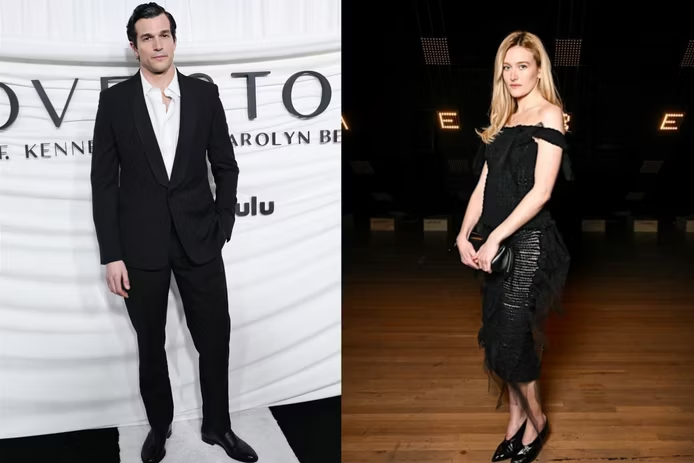
Fashion has always had a cyclical nature, but every so often, a revival feels bigger than just a trend. That’s exactly what’s happening with the return of ’90s minimalism—this time powered by what many are calling the “CBK effect.” Thanks to the recent buzz around Love Story, a new generation is rediscovering the understated, effortless style once embodied by Carolyn Bessette-Kennedy.
At its core, the CBK effect is about more than clothes. It’s about a mood—clean, controlled, and quietly confident. Think long black coats, crisp white shirts, straight-leg denim, and barely-there makeup. In a world saturated with fast fashion and loud branding, this stripped-back aesthetic feels refreshing. It signals intention rather than excess.
What makes this revival especially powerful is how it’s being driven. Love Story doesn’t just retell a romantic narrative; it visually reconstructs an era. Every outfit feels deliberate, rooted in archival references and tailored silhouettes. The result is a version of ’90s minimalism that feels timeless rather than costume-like. Viewers aren’t just watching the story—they’re absorbing a style language.
Social media has accelerated this effect dramatically. Platforms like TikTok and Instagram have turned Carolyn’s wardrobe into a kind of formula. Influencers and everyday users alike break down her looks into simple, replicable pieces: a structured coat, neutral tones, sleek sunglasses. These aren’t unattainable runway items—they’re accessible across price points. That accessibility is key to why the trend is spreading so quickly.
Another reason for the CBK effect’s staying power is rooted in scarcity. Carolyn Bessette-Kennedy was famously private, leaving behind a limited archive of interviews and public appearances. That absence has created space for projection. People aren’t just copying her outfits; they’re buying into an idea of her—composed, elegant, and effortlessly chic. In today’s oversharing culture, that kind of mystery feels rare and aspirational.
There’s also a broader cultural shift at play. After years dominated by maximalism—bold prints, heavy logos, and statement pieces—fashion is swinging back toward restraint. Minimalism today aligns closely with the idea of “quiet luxury,” where quality, fit, and fabric matter more than visible branding. It’s less about showing off and more about signaling taste.
Importantly, this trend is not limited to high fashion. Retailers across the spectrum are responding, from luxury houses to fast-fashion brands. Capsule wardrobes inspired by ’90s minimalism are being marketed as both stylish and practical. The message is clear: you don’t need more clothes—you just need the right ones.
The CBK effect ultimately highlights how storytelling shapes what we wear. When a cultural moment—like Love Story—connects emotion, nostalgia, and visual identity, it can influence not just trends but consumer behavior. It turns style into something people can participate in, not just observe.
In 2026, ’90s minimalism isn’t just back—it’s been redefined. And at the center of it all is a reminder that sometimes, the most powerful statement in fashion is simplicity.